
Commercial Roofing Services
TPO Single-Ply Roofing in Green Bay, WI
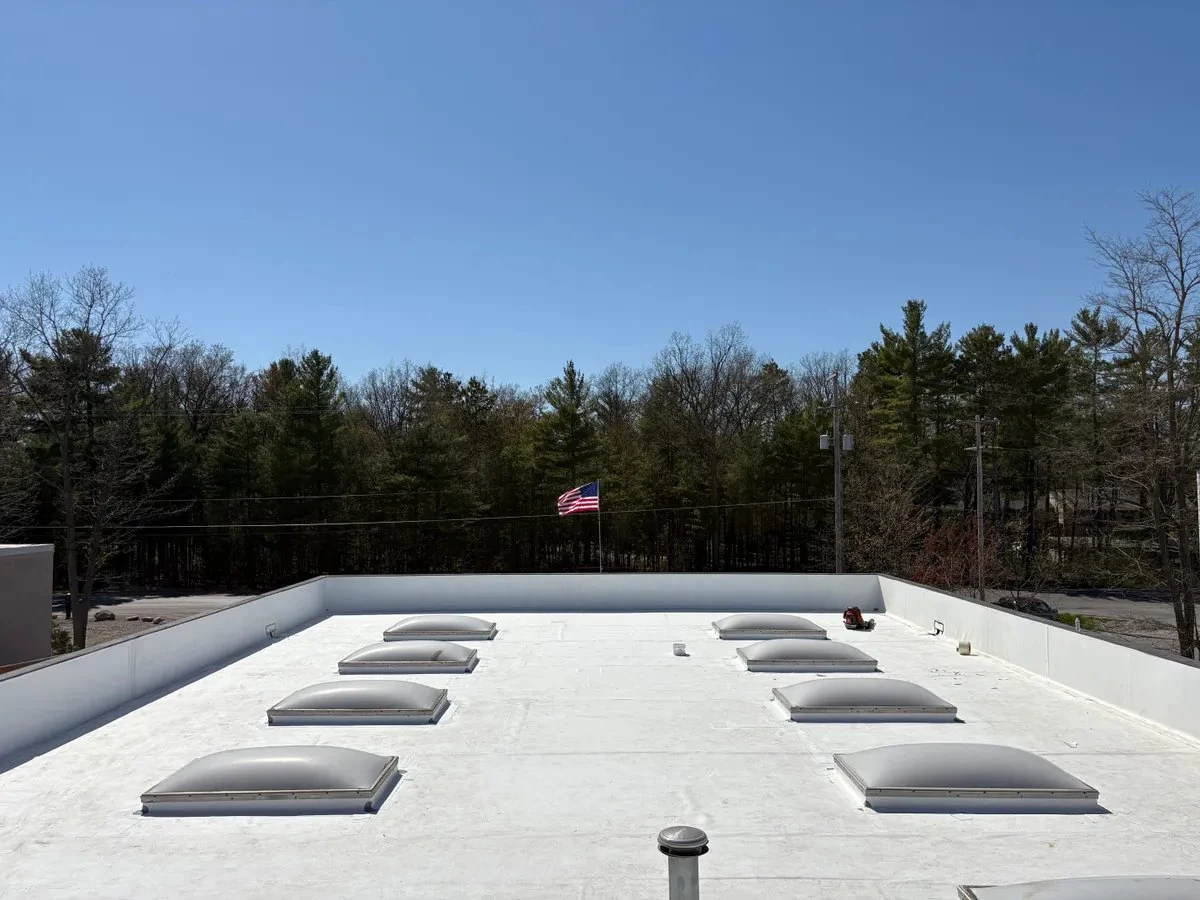
TPO Installation Service for Green Bay Warehouses, Plants, and Cold Storage Buildings
TPO is the single-ply membrane we install most often across Green Bay's warehouse, distribution, and food processing stock. Heat-welded seams, a range of mil thicknesses, and a reflective white surface make it a fit for a lot of the low-slope roof stock along the I-41 corridor and around the port. We scope every job against the building's actual traffic, exposure, and use before recommending a thickness or attachment method.
What Our TPO Installation Scope Covers
A TPO job starts with a site walk and, on any recover, a moisture scan of the existing roof. If the deck and insulation come back dry and the layer count is code-compliant, we build the new assembly over the old one with a cover board and fresh insulation. If the deck is wet or damaged, the scope shifts to a full tear-off, and we price the two paths separately so ownership can see exactly what the difference costs.
From there the scope covers insulation sized to current snow load and R-value requirements, the TPO membrane itself in the thickness that matches the roof's traffic pattern, heat-welded seams at every lap, and flashing detail at parapets, curbs, and penetrations. We close the job with a manufacturer field inspection before the warranty gets issued, not after.
Heat-Welded Seams on Large, Open Roof Planes
Distribution buildings around Lawrence and the I-41 corridor tend to have large, open roof fields with a standard perimeter and a manageable curb count. TPO's wide sheet widths cut down the number of seams on a roof that size, and each seam gets fused into a single polymer bond through hot-air welding rather than an adhesive lap. Fewer seams and a fused bond both work in the same direction: fewer places for a leak to start.
We probe every welded seam during the post-install walk, then again on the first-year inspection. A weld that looks fused on install day can still be under-welded if the ambient temperature was marginal, and that is the kind of defect that only shows up once winter tests it.
Reflective Membrane on Cold Storage and Food Processing Roofs
White TPO's reflectivity does more than trim a summer cooling bill on a normal office building. On the refrigerated warehouses and food processing plants around the port and the rail corridors, cutting solar heat gain at the roof surface reduces the load the refrigeration system fights, even on cold-climate days when the air temperature itself is not the problem. We spec white TPO on most cold storage work for that reason.
That reflectivity is not a substitute for a correctly designed vapor retarder underneath the insulation. Refrigerated buildings drive moisture vapor upward through the roof assembly year-round because of the temperature and humidity differential between the conditioned space and the deck, and the vapor retarder is what actually stops that moisture from condensing inside the insulation layer.
What a TPO Installation Includes
- Site walk, moisture scan, and recover-versus-tear-off recommendation
- Insulation package sized to current snow load and R-value code
- Cover board where required for the attachment method
- TPO membrane in the mil thickness matched to expected roof traffic
- Heat-welded seams at every field lap, probed and documented
- Flashing and detail work at parapets, curbs, and penetrations
- Manufacturer field inspection ahead of warranty issuance
Mechanically Fastened vs Fully Adhered Attachment
Roofs near the open bay and the working port see wind exposure that inland buildings in this county do not deal with, and that changes the attachment method we recommend. A mechanically fastened system needs a fastener and plate pattern set to the building's actual exposure category and roof height, not a generic table pulled off a spec sheet.
On buildings with heavy rooftop equipment traffic, we lean toward fully adhered or induction-welded attachment instead, since it keeps exposed fastener plates out from underfoot where crews are walking regularly. The recover assembly underneath still has to be checked for dead load capacity before either attachment method gets specified.
Scheduling a TPO Install Around Wisconsin Weather
Heat-welding TPO seams has a minimum application temperature, and Green Bay's install season effectively runs from spring thaw through the point in late fall when overnight lows start working against a clean weld. We do not schedule installs outside that window just to hit a deadline, because a seam welded in marginal cold can look fused on the surface while the bond underneath never fully sets.
For projects that need to start early in the season or run late, we watch the forecast daily rather than committing to a fixed date, and we stage the work so partially completed sections are never left exposed overnight if a cold snap or snow event is coming.
TPO Installation Questions We Field
How is TPO different from PVC if both are heat-welded?
Both use hot-air welded seams, but the underlying chemistry differs. PVC resists grease and chemical exposure better, which is why we spec it for exhaust-heavy food processing details, while TPO is usually the more economical choice on a clean warehouse or distribution roof.
Can TPO be installed over an existing EPDM roof?
Sometimes, as a recover with the right separator layer, but compatibility between TPO and old EPDM adhesives has to be checked first. We evaluate that case by case rather than assuming it works on every roof.
Does a thicker TPO membrane cost significantly more?
Material cost goes up with thickness, but on a roof with heavy foot traffic from HVAC or refrigeration service, the added puncture resistance of a heavier membrane usually pays for itself in fewer repair calls before the reroof clock runs out.
How long does a typical TPO installation take?
Roof size and deck condition drive the schedule more than crew size. A dry deck with straightforward flashing detail moves faster than a roof needing extensive repair, and we build the actual schedule once we have walked the roof, not from a generic estimate.
What voids a TPO warranty fastest?
Installing outside the manufacturer's minimum application temperature and adding rooftop penetrations after install without proper flashing are the two issues we see most often on service calls for roofs we did not originally install.